

The Complete Home Generator Buying Guide for 2026
What a home generator actually does
Every generator does the same fundamental thing: it burns fuel to spin an engine, and the engine turns an alternator that produces electricity. The differences that matter to you are not in the physics. They are in three questions.
How does the power reach your house? How does the generator start? And how long can it run before someone has to do something?
A portable unit produces power at the machine. You carry extension cords to it, or you have a transfer switch installed so it can feed selected circuits.
A permanently installed standby unit is wired into your electrical system through an automatic transfer switch. The power reaches your outlets exactly the way utility power does.
A portable unit starts when a person walks outside and starts it. A standby unit starts on its own, usually within seconds of detecting an outage.
A portable unit runs until its tank empties, then someone refills it. A standby unit connected to a natural gas line runs continuously.
The three types of home generator, compared honestly
Portable generators
These are the units you see stacked outside a hardware store when a storm enters the forecast. They are the least expensive way to keep a refrigerator and a few fans running, and for some households that is genuinely enough.
The tradeoffs are real. Someone has to be home to start it, which means the person who understands it has to be the person who is there. It has to sit outside, well clear of the house and away from windows and doors, because the exhaust is dangerous. It needs gasoline, which means a fuel supply that has to be stored, rotated, and replenished during exactly the week when every gas station in the county has a line or no power.
Inverter generators
An inverter generator is a portable unit with cleaner power output and, usually, quieter operation. The electronics condition the output so it is safer for laptops, televisions, and anything with a circuit board.
They are excellent for camping, tailgating, and running a handful of sensitive devices. They carry the same fundamental limitations as any portable: manual starting, manual refueling, and no connection to your home's wiring unless a transfer switch is installed.
Permanently installed standby generators
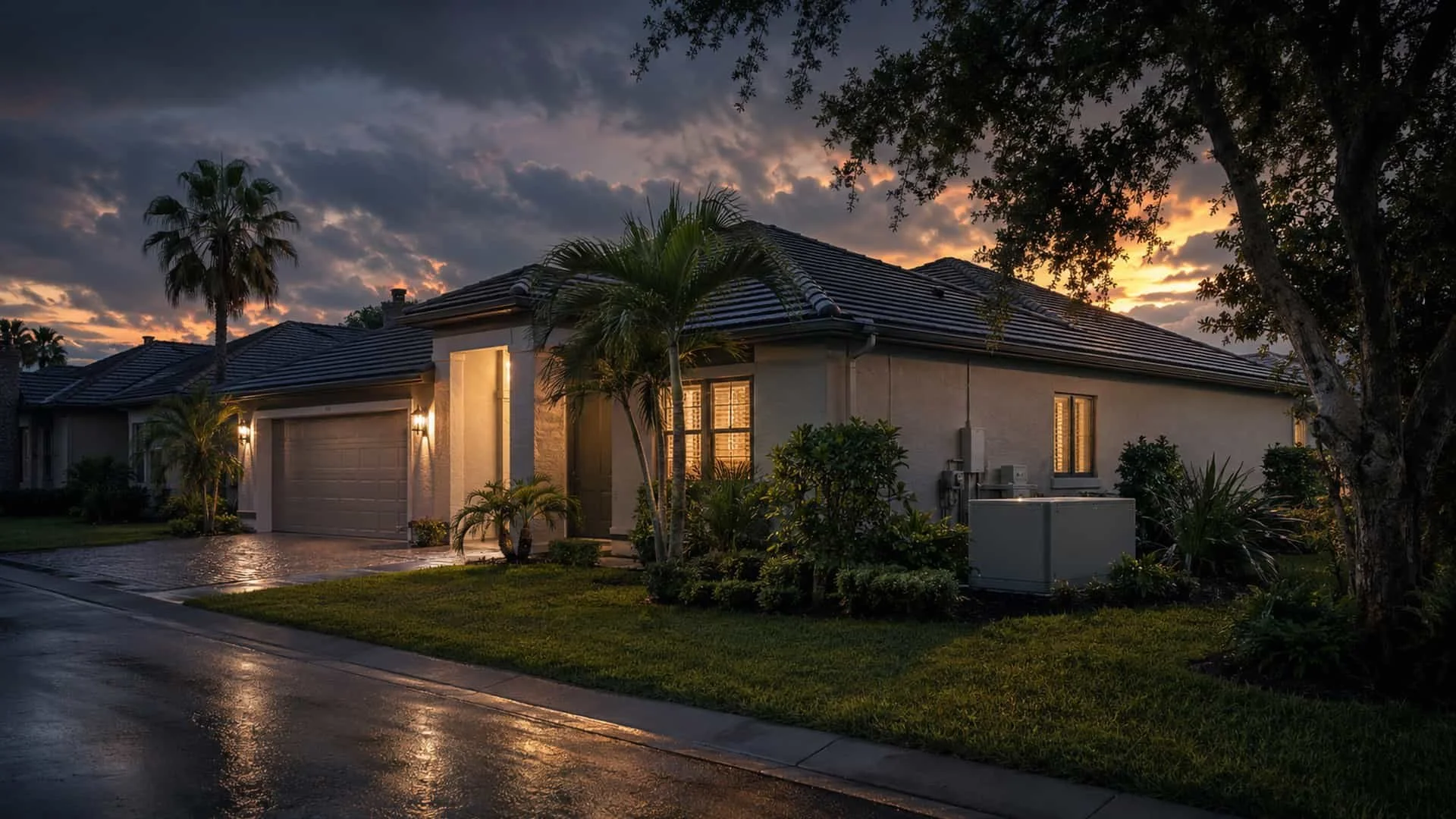
A standby generator is a permanent appliance. It sits on a pad outside your home, roughly the footprint of a large air conditioning condenser, and it is connected to two things: your electrical panel through an automatic transfer switch, and a fuel supply, usually a natural gas line or a propane tank.
When the grid drops, the transfer switch senses it, signals the generator to start, and moves your house from utility power to generator power automatically. When utility power returns and stays stable, it moves you back and shuts the generator down. Nobody has to be home. Nobody has to carry anything.
Fuel is the decision most homeowners underestimate
In Hillsborough and Pasco counties, the practical fuel choice for a permanently installed system comes down to natural gas or propane, and which one you can use is determined by your address, not your preference.
Natural gas arrives by underground pipeline. In much of the region that pipeline is operated by Peoples Gas System. Because the supply is underground and pressurized independently of the electrical grid, it generally keeps flowing through the kind of wind event that takes power lines down. A generator on natural gas has no tank to run dry.
Propane is stored in a tank on your property. It is the standard answer for homes on streets without a gas main, which describes a meaningful share of the more rural and newer-development parts of Pasco County and the western edge of Hillsborough. Propane burns clean and works well, but the runtime is finite and tied to tank size, which becomes a planning question rather than a problem.
Check whether a natural gas main runs to your street before you shop for a unit.
If you already have a gas range, gas water heater, or gas pool heater, the main is almost certainly there.
If you are on propane, tank sizing should be part of the same conversation as generator sizing, not an afterthought.
Fuel type affects the rated output of the same physical generator, so compare units on the fuel you will actually use.
Sizing: what actually determines the number
Generator capacity is expressed in kilowatts. The temptation is to pick a number that sounds generous and move on. That approach produces two bad outcomes: a unit too small to start your air conditioning, or a unit substantially larger and more expensive than your home will ever draw.
The right number comes from a load calculation, and a load calculation looks at two separate things. Running load is what your house consumes steadily. Starting load is the brief surge when a motor kicks on, and it can be several times the running figure. Air conditioning compressors, pool pumps, and well pumps are the usual culprits.
A few things about Florida homes make this calculation local rather than generic.
Many homes in the area run two air conditioning systems, and a home with two compressors has a very different starting profile than a home with one.
Pool pumps and pool heaters are common and are frequently left off a homeowner's mental list.
Well pumps in unincorporated Hillsborough and rural Pasco are large starting loads that municipal-water homes do not have.
Older panels sometimes have less headroom than the home's square footage would suggest, which affects what can be connected.
Load management devices can let a smaller generator cover a larger home by preventing two big loads from starting at the same moment.
Whole-home coverage versus essential circuits
These two phrases get used loosely, and the difference matters to your budget.
Essential-circuit coverage means a subset of your panel is backed up. Typically that is the refrigerator, some lighting, outlets in key rooms, the well pump if you have one, and one air conditioning system. Everything else stays dark until the utility returns.
Whole-home coverage means the entire panel is backed up and the outage is, from inside the house, close to invisible. You still run the dishwasher. You still use both air conditioning systems. The dividing line between the two is partly generator capacity and partly how the transfer switch is configured, which is why the conversation about size and the conversation about coverage have to happen together.
What a permanent installation actually involves in Hillsborough and Pasco
A permanently installed standby generator is not an appliance delivery. It is a permitted electrical project, and in both counties it has to be applied for by a licensed Florida electrical contractor.
Hillsborough County's published requirements for residential backup generators give a clear picture of what a compliant project looks like. A recorded certified copy of a Notice of Commencement is required under Florida Statute 713.13 before the first inspection. A site plan has to show setbacks and confirm the unit does not encroach into an easement or wetland setback. A load calculation is required where the unit is rated below the home's main service rating. Manufacturer clearance requirements have to be documented. If the fuel is gas, evidence of a fuel gas permit is required. Two inspections follow: an electrical rough-in, then an electrical final.
Flood zone matters here too. If the property sits in a Special Flood Hazard Area, the site plan has to show the minimum required design flood elevation, which affects how high the equipment pad is built.
Pasco County runs its own submittal process with its own portal and its own checklist, and the Florida Building Code applies statewide on top of both. This is the part of the project where local experience quietly saves weeks.
Questions worth asking before you buy anything
The equipment decision and the installer decision are not separate. A well-chosen generator installed poorly is a worse outcome than a modest generator installed correctly.
Is the company a Florida State Certified Electrical Contractor, and what is the license number?
Is it both a Generac Authorized Dealer and a Generac Certified Installer?
Who pulls the permit, and in which jurisdiction has that company most recently done it?
Will a load calculation be performed at my home, on my panel, before a size is recommended?
Does the quote include the pad, the transfer switch, the fuel connection, permitting, and inspection coordination?
What does the handover look like on the day the system goes live?
Talk to a Certified Installer Before You Choose a Unit
Tampa Backup Generators is a family-owned Generac Authorized Dealer and Generac Certified Installer serving Hillsborough and Pasco counties. We start with a free in-home assessment, calculate the load on your actual panel, and recommend a size that fits your house rather than a catalog.
Call 813-921-2072 to schedule your free in-home assessment.
Frequently Asked Questions
A unit connected to a natural gas line can run continuously for as long as the gas supply holds, because there is no tank to empty. A propane unit runs until the tank is depleted, so runtime depends on tank size and how much of the house is being powered.
Yes. Any generator permanently connected to your home's electrical system requires a permit and inspections, and the application has to be made by a licensed Florida electrical contractor. Confirm current requirements with your county's building department, because submittal checklists are updated periodically.
There is no square-footage shortcut that produces a reliable answer. The size comes from a load calculation performed on your actual electrical panel, accounting for your largest starting loads such as air conditioning compressors, pool pumps, and well pumps.
Not in the way a permanently installed standby system can. Portable units are limited by output, by the need for manual starting, and by fuel that has to be carried and replenished. Connecting one to your home's wiring safely still requires a properly installed transfer switch.
No fuel means no power. Natural gas distribution is underground and generally continues operating through wind events, but if service to your address is interrupted for any reason, the generator will not run until it is restored.
Clearances are set by the manufacturer's installation instructions and enforced through the permit, and they govern distance from windows, doors, vents, and combustible surfaces. Those clearances are part of what the site plan documents before the permit is approved.
Tampa Standby LLC | Florida State Certified Electrical Contractor | License #EC13015605