

Tampa Home Generator Service: How to Choose the Right Provider
Check the Florida electrical contractor license first
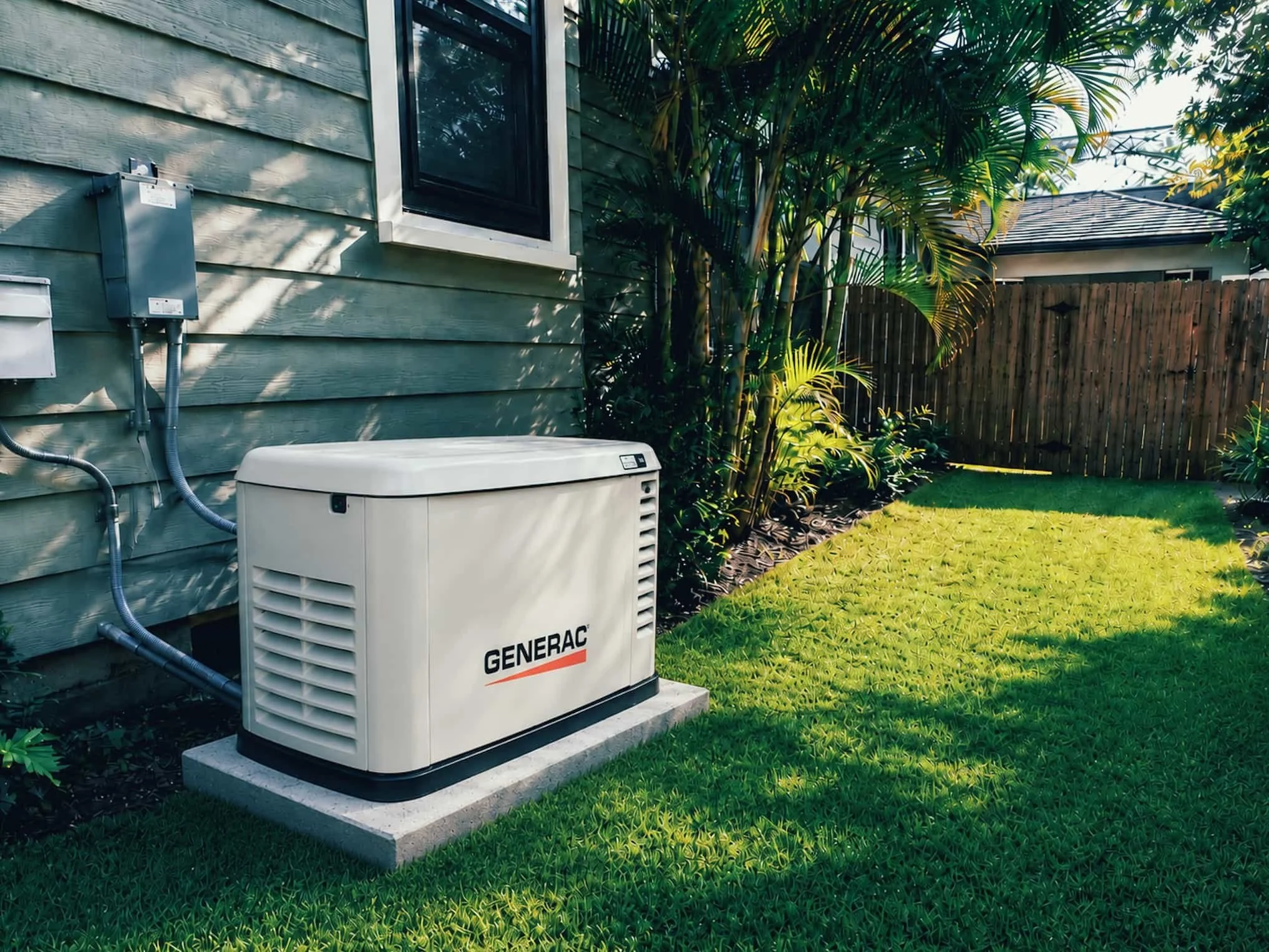
A permanently installed generator is wired into your home's electrical panel. In Florida, that work has to be performed under a licensed electrical contractor, and the permit application in Hillsborough County has to come from a Florida EC or ER licensed contractor.
Florida law also requires a certified or registered contractor to display their license number on their advertising. That means the number should be findable without asking. If you have to hunt for it, that is itself information.
Tampa Backup Generators operates as a Florida State Certified Electrical Contractor under license number EC13015605.
Look for the license number on the website, on the truck, and on the written proposal.
Confirm it is an electrical contractor license, not a general contractor or specialty registration from another trade.
Verify the number independently through the Florida Department of Business and Professional Regulation license lookup.
Confirm the license is active and that the name on it matches the entity on your proposal.
Ask for both Generac designations by name
There are two separate credentials, and companies sometimes present one as though it covers both.
A Generac Authorized Dealer has a direct relationship with the manufacturer to sell Generac equipment. A Generac Certified Installer has met the manufacturer's requirements for installing it. One is about supply. The other is about workmanship.
Ask the question plainly: are you a Generac Authorized Dealer and a Generac Certified Installer? A specific answer is a good sign. A general answer about being a Generac company is not the same thing.
Tampa Backup Generators is a family-owned Generac Authorized Dealer and Generac Certified Installer.
Local permit knowledge is not a small detail
Hillsborough County and Pasco County each run their own submittal process, their own portal, and their own checklist, and they are not interchangeable. A company that works one county fluently and the other rarely will feel very different on your project.
Hillsborough County's published requirements for residential backup generators give you a concrete way to test whether a company knows the ground. A compliant submittal includes a recorded certified copy of a Notice of Commencement under Florida Statute 713.13 before the first inspection, a site plan showing setbacks and confirming no encroachment into easements or wetland setbacks, a load calculation where the unit is rated below the home's main service rating, documented manufacturer clearance requirements, the location of any load shedding devices, and evidence of a fuel gas permit where the fuel is gas. Two inspections follow: electrical rough-in, then electrical final.
If your property sits in a Special Flood Hazard Area, the site plan also has to show the minimum required design flood elevation, which changes how the pad is built.
You do not need to memorize any of that. You need to hear a company describe it without hesitating.
What a real in-home assessment looks like
A quote produced over the phone from your square footage is a price, not a recommendation.
A genuine assessment happens at your house and covers a specific list.
The electrical panel is opened and evaluated, including its capacity and its available headroom.
A load calculation is performed against your actual circuits, with attention to starting loads from air conditioning compressors, pool pumps, and well pumps.
Fuel is confirmed at the address, including whether a natural gas main serves the street or whether propane and a tank are the route.
Candidate locations for the unit are walked, checked against manufacturer clearances from windows, doors, and vents, and checked against setbacks and easements.
Flood zone status is checked, because it affects pad elevation.
Whole-panel versus essential-circuit coverage is discussed explicitly, so you know what will and will not be running.
You are told which jurisdiction will issue the permit and roughly what that review looks like right now.
Red flags worth walking away from
None of these are subtle, and all of them show up in this market.
A firm price before anyone has seen your electrical panel.
No license number anywhere on the advertising or the proposal.
Pressure tied to a storm currently in a forecast cone.
A recommended size with no load calculation behind it.
A quote that does not clearly state who pulls the permit and who schedules inspections.
Vagueness about whether the pad, the transfer switch, the fuel connection, and inspection coordination are included.
A deposit request with no written scope attached.
How to compare two quotes fairly
Two proposals with a meaningful gap between them are usually not quoting the same job. Before assuming one company is expensive, line the scopes up.
Check whether both quotes are for the same fuel, because the same physical unit carries different output ratings on natural gas and on propane. Check whether both include the concrete pad, the automatic transfer switch, the fuel line connection, permitting, and inspection coordination. Check whether both are quoting whole-panel coverage or one is quoting essential circuits. Check whether either assumes an electrical panel upgrade that the other has left out.
Once the scopes match, the comparison becomes real.
Frequently Asked Questions
Ask for the license number, then look it up through the Florida Department of Business and Professional Regulation. Confirm the license is active, that it is an electrical contractor license, and that the name on it matches the company on your proposal.
Yes. Any generator permanently connected to your home's electrical system requires a permit and inspections, and the application has to come from a licensed Florida electrical contractor. Confirm current requirements with the county building department, since checklists are updated periodically.
The question that matters more is which company holds the right credentials and knows your county's permitting process. Both models can meet that bar and both can miss it, which is why the license check and the certification questions come first.
Review timelines vary with volume and with how complete the submittal is, and they lengthen during hurricane season. A company that works the county regularly should be able to tell you what current review is running rather than quoting a generic figure.
The unit series and model, the fuel it is rated on, the transfer switch and the coverage it provides, the pad, the fuel connection, permitting and inspection coordination, and what happens at activation and handover.
Tampa Backup Generators installs whole-home standby generators across Hillsborough County and Pasco County.