

Backup Power Generators Explained: Which Option Is Best for Your Home?
The four options, in plain terms
Portable generators
A gasoline engine on a frame with wheels. It produces power at the machine, and you either run extension cords to it or have an electrician install a transfer switch so it can feed selected circuits.
It is the lowest-cost entry into backup power, and for a household that only needs a refrigerator and a couple of fans, it can be a reasonable answer. It is also the option that demands the most from you: someone starts it, someone monitors it, someone refuels it, and it must sit well clear of the house because the exhaust is dangerous.
Inverter generators
A portable unit with conditioning electronics that produce cleaner output and, generally, quieter operation. Better for sensitive electronics, better for a neighborhood at 2am.
Same fundamental profile as any portable: manual start, manual refuel, limited output, no automatic connection to your home's wiring.
Home battery storage
A wall-mounted or cabinet battery system that charges from the grid or from solar and discharges when the grid drops. Silent, no fuel, no exhaust, and no attention required during an outage.
The constraint is stored energy. A battery holds a finite amount and, without solar generation to recharge it, it depletes. In a short outage that is invisible. In a multi-day outage with air conditioning running in Florida heat, it becomes the whole story.
Automatic standby generators
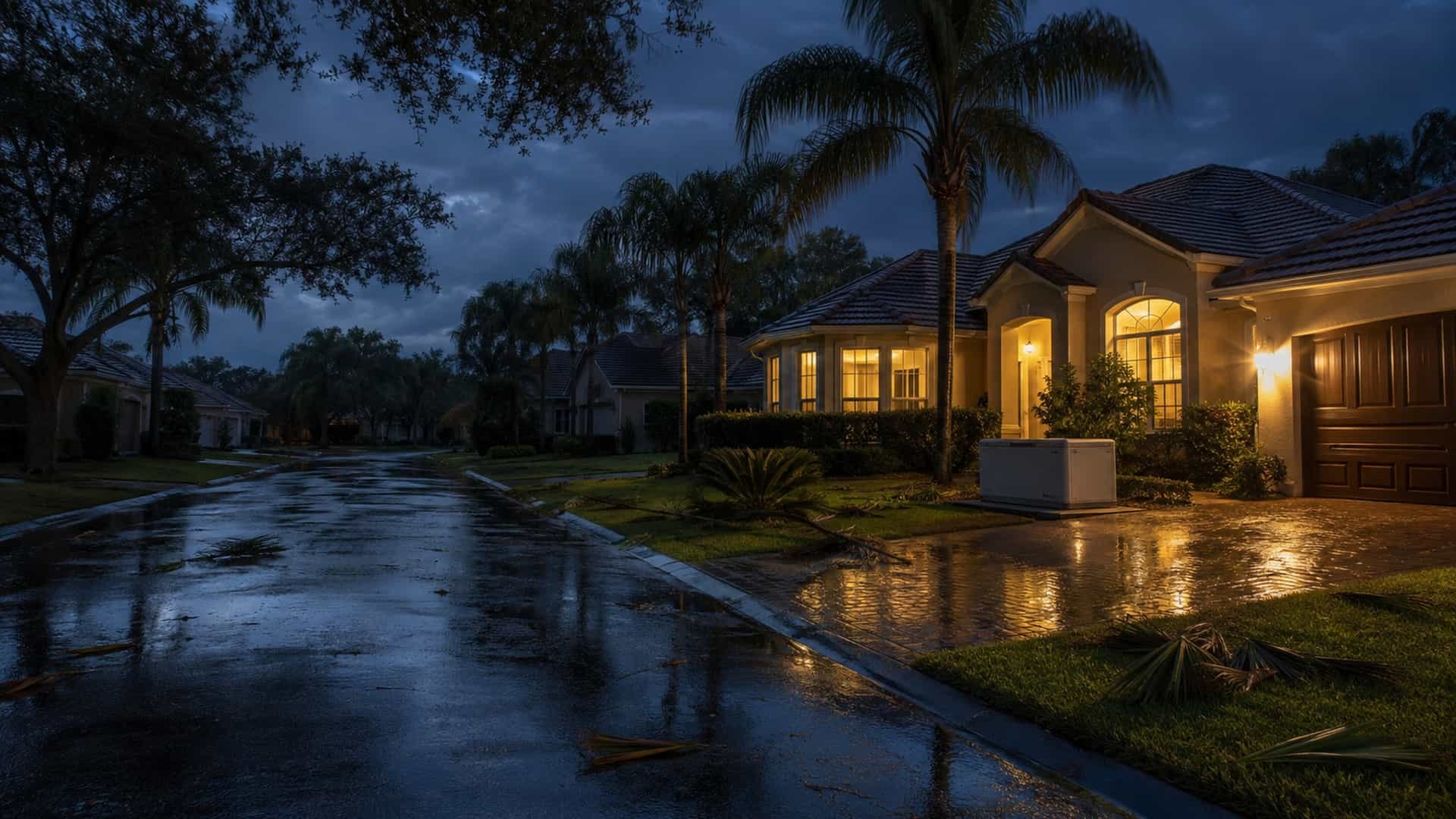
A permanently installed unit connected to your electrical panel through an automatic transfer switch and to a fuel supply, usually a natural gas line or a propane tank.
It starts on its own within seconds of an outage, powers the house through the transfer switch, and shuts down when utility power returns and stabilizes. Nobody needs to be home. Nothing needs to be carried.
How each one behaves in a multi-day outage
This is where the comparison stops being theoretical.
A portable unit needs fuel, and fuel needs a functioning gas station. During a widespread outage, stations without power cannot pump, and the ones that can have lines.
An inverter unit has the same fuel problem, with a smaller tank in most cases.
A battery system needs recharging. Without solar, or with solar under heavy cloud cover, it does not refill.
An automatic standby unit on a natural gas line has no fuel logistics at all, because the supply is continuous and underground.
An automatic standby unit on propane has a defined runtime tied to tank size, which is a planning question you settle before the storm rather than during it.
Why automatic standby became the whole-home default
Three things drove this, and none of them is marketing.
The first is unattended operation. Outages do not schedule themselves around your travel. A system that requires a person to start it is not backup power for a house that is empty, and half of a hurricane's disruption is people being somewhere else.
The second is capacity. Air conditioning is not optional in a Florida summer, and it is a large starting load. Portable units and most battery systems struggle to start a compressor, let alone two. Permanently installed units are sized against that specific problem.
The third is that the connection is permanent and inspected. There are no cords across a wet lawn, no backfeeding risk, no improvised arrangement that a home inspector or an insurer will later ask questions about.
The transfer switch is the component nobody shops for
Everyone compares generators. Almost nobody compares transfer switches, and the transfer switch is the part that determines what the experience actually feels like.
A manual transfer switch requires a person to physically move the house from utility to generator. It is inexpensive and it works, and it is still a person standing at a panel in the dark.
An automatic transfer switch senses the outage and does it for you, then reverses when the utility returns. It also handles the safety-critical job of ensuring your generator can never feed power back into the utility lines, which is what protects line crews working to restore your neighborhood.
Beyond the automatic-versus-manual question, the switch is also where coverage is defined. A whole-panel switch backs up everything. A subpanel arrangement backs up a defined set of circuits. Deciding which is right is the same conversation as deciding what size unit you need, and it should happen at the same time.
Matching the option to your actual situation
A short set of questions usually resolves this faster than a spec comparison.
How long do your outages typically last, and what is the worst one you have had?
Is anyone reliably home during storm season, or does the house sit empty?
Does anyone in the household depend on powered medical equipment?
Do you have a well pump, a septic pump, or a pool that has to keep circulating?
Do you need one air conditioning system running, or two?
Would you rather store fuel, store energy, or store neither?
What installation involves once you have chosen
Any backup power system that connects to your home's wiring is a permitted electrical project in Hillsborough and Pasco counties, and the permit has to be applied for by a licensed Florida electrical contractor.
For a permanently installed standby system, the sequence is consistent: an in-home assessment and load calculation, a site plan showing setbacks and clearances, a recorded Notice of Commencement, permit submittal, pad and fuel work, the electrical rough-in inspection, the electrical final inspection, then startup, testing, and handover.
If the property is in a Special Flood Hazard Area, elevation requirements affect how the pad is built and must be reflected on the site plan before approval.
Frequently Asked Questions
Backup generator is the general category for anything that produces power when the grid is down. Standby generator refers specifically to a permanently installed unit wired into your electrical system that starts automatically through a transfer switch.
It depends on outage length. A battery covers short interruptions well and silently. In a multi-day outage with cooling loads running, stored energy depletes unless there is generation recharging it, which is why many Florida homeowners pair thinking about batteries with thinking about a fueled system.
Any generator permanently connected to your home's wiring requires a properly installed transfer switch, and permanent standby installations are designed around an automatic one. The switch is what prevents power from feeding back into utility lines.
Typically within seconds of the transfer switch detecting the loss of utility power. There is a brief interruption while the unit starts and the switch transfers, so sensitive equipment that cannot tolerate any gap still needs its own uninterruptible supply.
Yes, a licensed electrical contractor can install a transfer switch designed for a portable unit, which is safer than running cords. You still start and refuel the generator manually, and output limits what can run at once.
Policies vary and this is a question for your carrier, not your installer. What is consistent is that a permitted, inspected installation is documented work, while an improvised connection is not.